
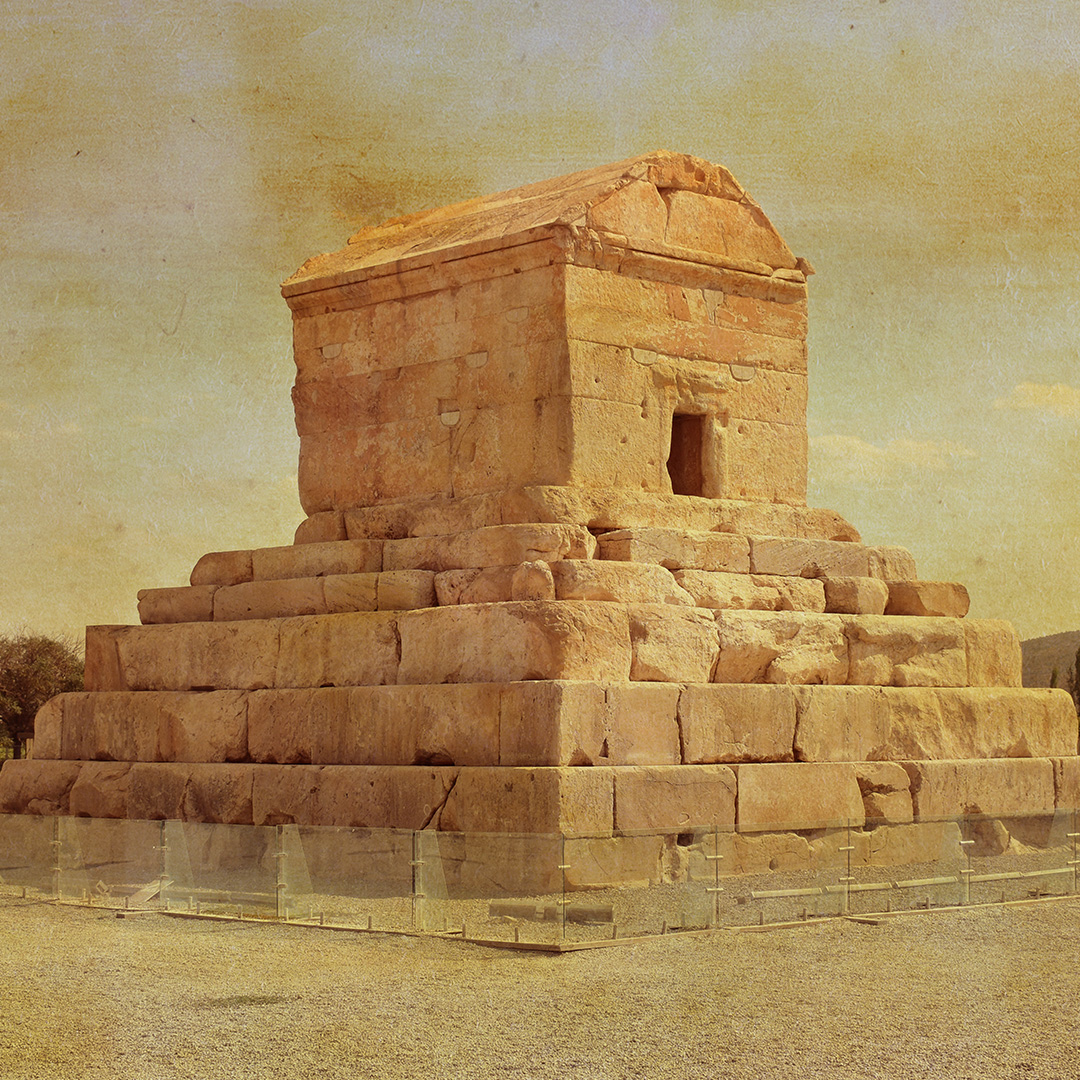
Iran has an extensive and opulent antiquity. The region has been inhabited almost since the end of the flood. It was in about 2,000 BC that the Aryan people appeared on the scene and then broke into two basic factions—the Medes and Persians. The Aryan influence would be felt not only in Persia, but much later in European countries.
Before the area we know today as Iran was ruled by the Medes and Persians, it was first under the control of the Elamites, Assyrians, and Babylonians. The Elamites, a fierce warrior tribe, were the initial rulers over the region. Elam, the progenitor of the band, was the son of Shem and the grandson of Noah. The capital city of the ancient kingdom was Shushan or Susa. It was the jewel in the crown of the Elamites and stood proudly until razed by the Mongols under the leadership of Genghis Khan in 1218 BC.
Historical records indicate that the Elamites were constantly engaging in wars with Assyria and Babylonia in an attempt to control the Mesopotamian plateau. Following centuries of conflict, the Elamites allied themselves with armies from the Susiana Plain and overran Ur of the Chaldeans. The fierce tribe and its allies also subjugated many of the lands that had been dominated by the Babylonians before setting its sights on the kingdom of Babylonia.
Elam first appears in Genesis 10 in the lineage of Noah. The second instance is in Genesis chapter 14 when Chedorlaomer, the king of the Elamites, joined forces with five other Mesopotamian leaders in the region, including the kings of Sodom and Gomorrah. Together they launched a campaign to attack and subdue the territory, and after having put them to flight, they sacked the cities and carried off the inhabitants, among them Abraham’s nephew, Lot, and his family. Abraham and his 300 trained warriors then set out to successfully rescue his family members—not by their own might, but by the hand of God.
The prediction of the downfall of the ferocious army of Elam can be found in the books of Jeremiah and Ezekiel in the Old Testament. In Jeremiah 49, God pronounces judgment upon Elam: This is what the Lord Almighty says: “See, I will break the bow of Elam, the mainstay of their might. I will bring against Elam the four winds from the four quarters of heaven; I will scatter them to the four winds, and there will not be a nation where Elam’s exiles do not go. I will shatter Elam before their foes, before those who want to kill them; I will bring disaster on them, even my fierce anger,” declares the Lord. “I will pursue them with the sword until I have made an end of them. Jeremiah prophesies that the Elamite armies will be reduced to nothing—unable to effectively sustain superiority in battle.
Famous for their archers, it was predicted that the bows of the troops would be, not just ineffective, but broken, useless. The populace would then be driven out by fear of their conquerors and scattered throughout the kingdoms of their enemies. If that were not a sufficient pronouncement, the Elamites would be fleeing those whose only intent was to inflict evil. Elam is mentioned only once in the New Testament in Acts 2:9. On the Day of Pentecost, descendants of the Elamites were in Jerusalem as the disciples began to preach to those in the streets. The Elamites gave way to the Assyrians and then the Babylonians before the Medes and Persians subjugated the peoples in the region. It has been conjectured that the Persian people originated in Medea, which today is found in southern Azerbaijan and western Iran. The group established a base on the Persian Gulf.
The prophet Ezra recorded: In the first year of Cyrus king of Persia, in order to fulfill the word of the Lord spoken by Jeremiah, the Lord moved the heart of Cyrus king of Persia to make a proclamation throughout his realm and to put it in writing: This is what Cyrus king of Persia says: “The Lord, The God of heaven, has given me all the kingdoms of the earth” (Ezra 1:1-2). Biblical history was also shaped by ancient empires that included the Egyptians, Assyrians, Babylonians, Persians, and the Romans.
It was the Persians under Cyrus who allowed Ezra and Nehemiah to rebuild the Temple: “and he has appointed me to build a temple for him at Jerusalem in Judah. Any of his people among you may go up to Jerusalem in Judah and build the temple of the Lord, the God of Israel, the God who is in Jerusalem, and may their God be with them” (Ezra 1:2-3). Seventy years after King Nebuchadnezzar had razed Jerusalem, looted the Temple, and carried the Israelites captive to Babylon, Cyrus granted permission for them to return to their homeland.
One can but wonder how much history the descendants of the Persians (today’s Iranians) have had to rewrite in order to erase the move that returned the Jewish people to the land the Palestinians now claim belongs to them. Other books in the Old Testament—II Chronicles, Ezra, Nehemiah, Esther, Ezekiel, Daniel, Haggai, Zechariah, and Malachi— include mentions of the Persians in their texts. The empire played an important part in the diaspora of the Jews and in their restoration. Simply stated, the ancient Persians believed in grandeur and practiced it accordingly. Their history and culture reflect that it was one of the grandest kingdoms of all.
Over 2,500 years ago, the Hebrew prophet Daniel was taken captive to Babylon. He was near the palace on the night King Darius and his troops rerouted the Euphrates River and entered Belshazzar’s stronghold. The king and his courtiers had spent the 26th night in drunken revelry—up to the moment God had captured their attention: “While Belshazzar was drinking his wine, he gave orders to bring in the gold and silver goblets that Nebuchadnezzar his father had taken from the temple in Jerusalem, so that the king and his nobles, his wives and his concubines might drink from them. So they brought in the gold goblets that had been taken from the temple of God in Jerusalem, and the king and his nobles, his wives and his concubines drank from them. As they drank the wine, they praised the gods of gold and silver, of bronze, iron, wood and stone. Suddenly the fingers of a human hand appeared and wrote on the plaster of the wall, near the lampstand in the royal palace. The king watched the hand as it wrote. His face turned pale and he was so frightened that his legs became weak and his knees were knocking” (Daniel 5:2-6).
Belshazzar was terrified and called for his diviners to determine the meaning of the message. The queen reminded her husband of Daniel who was “found to have a keen mind and knowledge and understanding, and also the ability to interpret dreams, explain riddles, and solve difficult problems.” The king quickly sent a servant to fetch Daniel to the banqueting room where he was asked to explain to Belshazzar what had just happened and why: “You had the goblets from his temple brought to you, and you and your nobles, your wives and your concubines drank wine from them. You praised the gods of silver and gold, of bronze, iron, wood and stone, which cannot see or hear or understand. But you did not honor the God who holds in His hand your life and all your ways. Therefore He sent the hand that wrote the inscription. This is the inscription that was written: mene, mene, tekel, parsin. Here is what these words mean: Mene: God has numbered the days of your reign and brought it to an end. Tekel: You have been weighed on the scales and found wanting. Peres: Your kingdom is divided and given to the Medes and Persians” (Daniel 5:23-28).
That very night, the Babylonian ruler was slain. Darius, the king of the Medes, became lord of the land and Nebuchadnezzar and his offspring became ancient memories to the inhabitants. Persia had stepped onto the stage of powerful players. Some scholars believe that the name Darius was not a proper name at all, but a title of honor meaning “Holder of the Scepter.” In other words “The Scepter Holder (King) of the Medes.” The Jewish historian Josephus also recorded that: “Darius the Mede, who along with his relative, Cyrus the King of Persia, brought an end to the Babylonian empire. Darius was the son of Astyages.”
After Darius swept through Babylon and took control, he erected a resplendent citadel in the city of Shushan. It later became the home of Ahasuerus (aka, Artaxerxes II) the king who took Esther as his queen. Islamic tradition intimates that the tomb of the prophet Daniel is also located in the present-day town of Shush located in southwestern Iran near the Iraqi border. The Bible contains many references to the rulers of Persia, but not all refer to Cyrus, Darius, or Ahasuerus. Daniel, after having been carried captive from Jerusalem to Babylon, turned to the Lord and repented for the sins of his nation. He asked for forgiveness on their behalf, and prayed God’s Word and His will concerning them would be fulfilled.
Daniel was told that his prayer had been heard from the moment it was uttered, but the “prince of Persia” (a demonic being such as those mentioned in Ephesians 6:12) resisted Gabriel for 21 days. He was also told that Michael the archangel had joined Gabriel in battling this demonic power. What was the result of Daniel’s steadfastness in prayer? Deliverance! Daniel knew his most important assignment was prayer. That was confirmed to him by the battle in the heavenlies between demons and angels, between good and evil.
The city of Babylon was one of the Seven Wonders of the Ancient World. It was considered impregnable, but Daniel, through the power of prayer, was able to “be strong, and carry out great exploits.” It is puzzling that, with such a rich history and the witness of devout followers of the God of the Bible—Esther, Mordecai, Daniel, Shadrach, Meshach, Abednego—the Iranians are not worshippers of Yahweh. This concept is supported by the contents of museums, textbooks, and even the universities in the country. And yet, 99 percent of Iran’s inhabitants are practicing Muslims…followers of Mohammad and worshippers of Allah. They adhere to the teachings— not of the Bible, but of the Koran. Christians and Jews are met with increasing hatred and antagonism.
As offspring of the early Persian people, Iran has a significant role in Bible prophecy and end-time events. The prophet Ezekiel envisioned a war against Israel launched by what many have determined to be Russia, Iran, and a multi-national coalition. Many evangelical Christians see this as an alliance formed between Russia and Iran for the purpose of attacking the Jews in the Middle East. The war of Gog and Magog was predicted to hit Israel after the Jews returned to their homeland. The prophecy also speaks of this as a time when Israel is “brought back from the sword.” In other words, the war will occur when Israel is at peace.
As the nuclear crisis with Iran deepens, millions of Christians worldwide are consulting their Bibles and praying to sort out how current world events fit into “last days” prophecies. Ezekiel 38:21-22 predicts massive human carnage as a result of the war. That Israel will ultimately win this Great War is little consolation given the mammoth number of deaths Ezekiel predicts as a result of the conflict.